
Scientific Research - Back to the Future


The Trump Administration’s recent moves against universities raises an important question for America – What is the role of government funding in research? In 2023, the government spent $60 billion on university research.
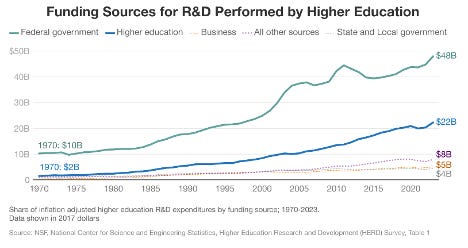
The administration recently froze $2.3 billion of grants to Harvard. And Harvard is not alone; they have also gone after other major recipients including Columbia and Johns Hopkins.
The universities are in full-on emergency P.R. mode, voicing a full-throated insistence that they a critical to scientific research in America. Yet they are blind to their unfounded assumptions that only universities can conduct important research and that government funding is the best way to pay for such endeavors.
Government grants don’t just fund research – they include funding for overhead, which in Harvard’s case amounts to a 69% markup on the money spent in the lab.
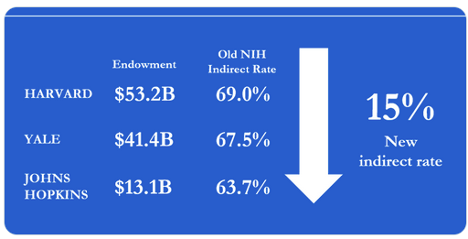
As taxpayers, we should be asking what we are getting for this expenditure. Have our research scientists cured cancer or invented clean energy? Other than subsidizing university administrators by $9 billion per year, how is this serving the American public?
If we look to the past, we find that the British solved the problem of government funded research in 1714.
One of the most difficult problems in the seventeenth and eighteenth centuries was ships getting lost and wrecked at sea. Between 1550 and 1650, 20% of ships sailing from Portugal to India were lost at sea. Ships could easily determine how far north and south they were (lattitude) by observing the angle of the sun at noon or the length of the day. However, they had no idea how far east or west they were on the globe (longitude), other than by dead reckoning - estimating distance traveled for a starting point, which was often overwhelmed by currents and estimate errors. The horrific cost in lives and wealth came to the forefront in 1707, when a British fleet under the command of Admiral Sir Cloudesley Shovell sailed headlong into the Isles of Scilly off the coast of Cornwall with the loss of 2,000 lives, including many from prominent families.
In 1714, a group of British merchants and sea captains brought a petition to Parliament to put up a prize to be awarded to whomever could solve the longitude problem. Parliament listened and passed the Longitude Act on July 8, 1714. The award was for up to £ 20,000 with smaller prizes also avaialble, depending on the accuracy of the solution. While this might translate into approximately $3 million today, it was the equivalent of 700 years of wages for a skilled craftsman.
Scientists and inventors tried many methods of solving the problem, including the lunar distance to known stars and even observations of the moons of Jupiter. In 1753, a German astronomer created accurate tables of lunar positions versus the stars and his heirs were finally awarded a £ 3,000 prize in 1765.
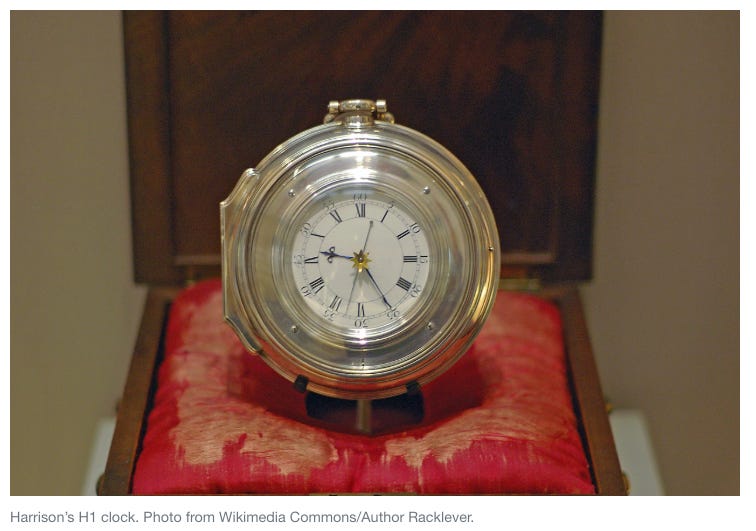
However, it was John Harrison’s work on creating an accurate clock that could withstand the shipboard conditions of violent motion and extreme changes in temperature and humidity that claimed the largest price. His fourth model, the H-4, succeeded in maintaining accurate time in a 1761 voyage. Harrison was finally awarded the prize in 1773, at age 80. Today we call Harrison’s clock a chronometer.
Coming back to today, we face numerous important medical and scientific questions. Rather than taxpayers funding research at universities, with no accountability for finding solutions, we should adopt a national program of establishing prizes for accomplishing results.
Chemotherapy is barbaric. Why not a $10 billion prize for curing breast cancer, another $10 billion for lung cancer, etc., with smaller awards for proven extension of quality of life for cancer patients?
There is no shortage of funding available for research. Venture Capital funds are estimated to hold approximately $650 billion of dry powder, with Private Equity funds sitting on an additional $1.5 trillion. If only 3% of these funds were directed to research, seeking prize money and the attendant commercial rewards, funding would exceed the amount currently spent unaccountably by the government. Let’s put America’s capital to work by directly incentivizing scientific progress.
It would be nice to see VC and PE capital deployed on hard research instead of projects selling dollar bills for 50 cents (VC) and HVAC/ Vet roll-ups (PE).